
What’s Your Flynn Score?
What's your Flynn Score?
I built a scoring system for designers. It changed every performance review I've had since.
I call it the Designer Ledger. A running +1/-1 score across six categories, reviewed quarterly.
The secret is when it gets logged. Not at the end of the month. Not reconstructed before the review. At the time of the incident. That single rule is what separates this from every other performance system I've seen.
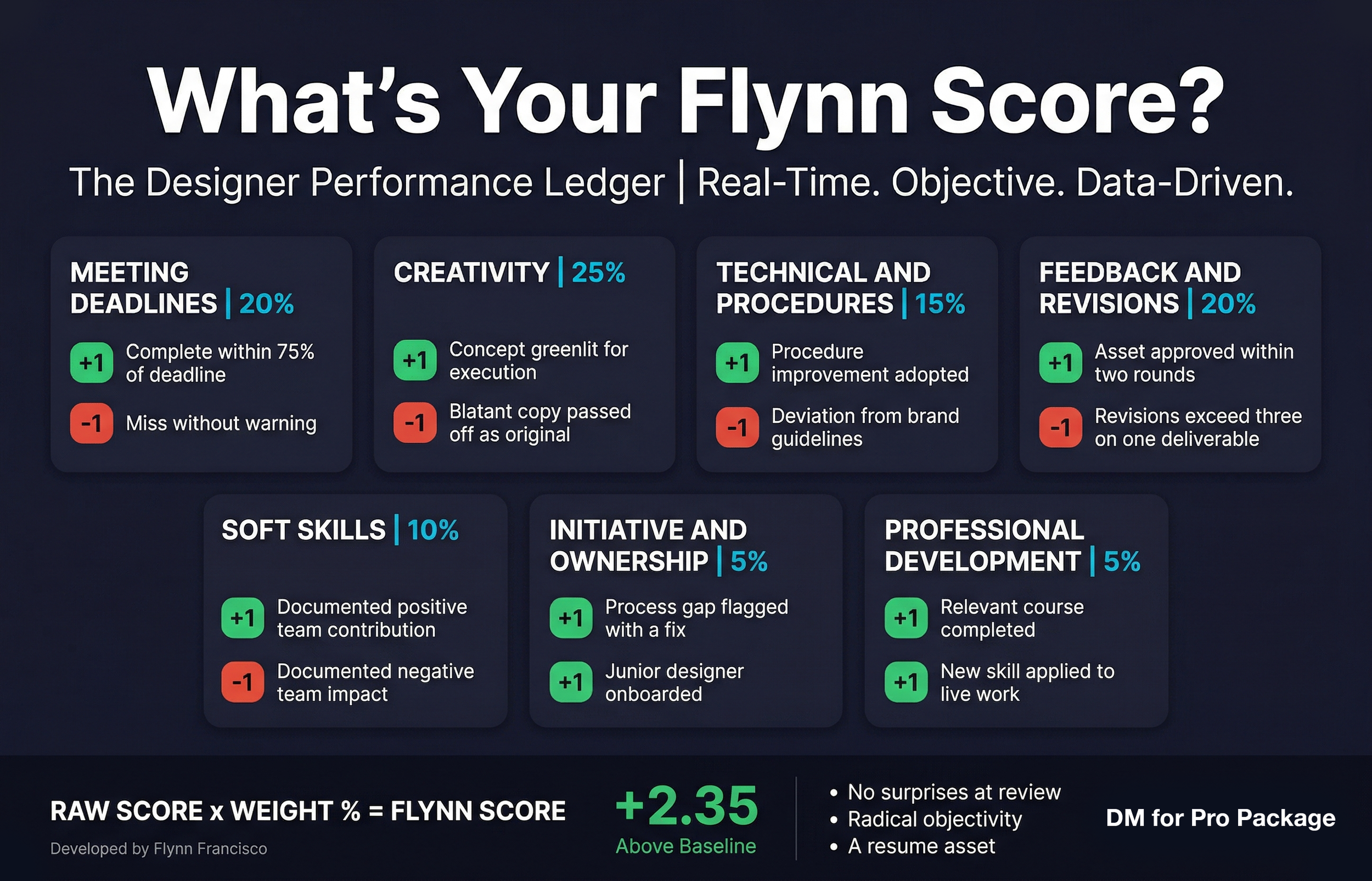
The six categories, how they score, and how much they count:
Meeting Deadlines (20%) +1 Complete within 75% of the given deadline +0 Proactive renegotiation -1 Miss without warning Note: 3+ renegotiations in a quarter is a manager conversation, not a designer penalty
Creativity (25%) +1 Concept greenlit for execution +0 Concept pitched but not approved -1 Blatant copy or simple template adaptation passed off as original work Benchmark: Set by the Creative Director at the start of each quarter based on workload and campaign volume. Default is +6.
Technical and Procedures (15%) +1 Suggest a procedure improvement that gets adopted +0 Meets all technical and brand requirements as expected -1 Deviation from brand guidelines, workflow, or technical requirements
Feedback and Revisions (20%) +1 Final asset approved within two rounds +0 Revisions land within the standard three round threshold -1 Revisions exceed three on a single deliverable -1 Repeats at every multiple of three Note: Beyond nine revisions it becomes a briefing problem, not a designer problem
Soft Skills (10%) +1 Documented positive contribution to team culture +0 Consistent professional conduct with no notable incidents -1 Documented negative impact on team performance Note: Vague impressions don't count
Initiative and Ownership (5%) +1 Flag a process gap with a proposed fix +1 Contribute to onboarding a junior +1 Propose a workflow that gets adopted Cap: +3 per quarter
Professional Development (5%) +1 Complete a relevant course or workshop +1 Demonstrate a new skill applied to live work Cap: +2 per quarter
How the Flynn Score is calculated
Each category has a raw score based on logged incidents across the quarter. That raw score is multiplied by its category weight to produce a weighted score. All weighted scores are added together for the Flynn Score.
Here is what that looks like for a real quarter:
Meeting Deadlines: raw score +3 x 20% = 0.60 Creativity: raw score +5 x 25% = 1.25 Technical and Procedures: raw score -1 x 15% = -0.15 Feedback and Revisions: raw score +2 x 20% = 0.40 Soft Skills: raw score +1 x 10% = 0.10 Initiative and Ownership: raw score +2 x 5% = 0.10 Professional Development: raw score +1 x 5% = 0.05
Flynn Score: +2.35
A positive score means the designer is operating above baseline. A negative score opens a structured conversation. The number is not a verdict. It is a starting point.
Category scores are reviewed individually, not just as a total. A strong Creativity score does not offset a pattern of missed deadlines.
Quality remains at the discretion of the Creative Director or design manager. The Ledger measures behaviour and consistency. Quality is the lens through which the conversation is had.
The Flynn Score doesn't close the conversation. It opens it.
At the quarterly review, a designer sits down knowing their number. The review becomes a discussion about what drove it, not a debate about whether there is a problem.
If your performance reviews still feel like guesswork, the issue probably isn't your designers.
It's that nobody has been keeping score.
Q1 is just getting started. There is no better time to begin tracking than right now. By the time June hits you will have a full quarter of logged incidents, real data, and a Flynn Score that actually means something.
A consistent Flynn Score is also a career asset. For designers it is a standard operational measure that stands out on a resume. For recruiters it offers something most portfolios never provide: a way to evaluate a designer operationally, not just visually.
What's your Flynn Score?
#DesignOperations #CreativeLeadership #DesignManagement #CreativeStrategy #DesignTeams